


How Standalone Controller works
How Standalone Controller works
Frequently Asked Questions
Q.What is a Standalone Controller in access control?
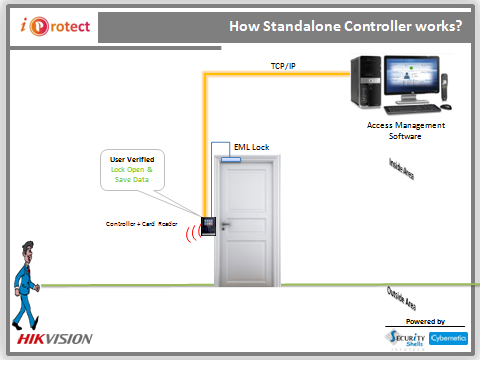
A standalone controller is a self-contained access control unit that manages door access without requiring a continuous connection to a central server. It stores user credentials, access rules, and event logs locally.
Q.How does a HIKVISION Standalone Controller work?
The controller connects to card readers or biometric devices on the input side and door locks (EM/Strike/Deadbolt) on the output side. It processes authentication decisions locally and communicates event data via TCP/IP to management software.
Q.What is the advantage of a standalone controller over a networked controller?
Standalone controllers continue to operate normally even if the network connection is lost, ensuring uninterrupted door access control. They are simpler to install and lower in cost for small deployments.
Q.Can a HIKVISION Standalone Controller be managed remotely?
Yes. Via TCP/IP connectivity, the HIKVISION standalone controller can be managed using iProtect or HIKVISION's access control management software for remote configuration, user management, and report generation.
Q.How many doors can a standalone controller manage?
A typical HIKVISION standalone controller manages 1 to 4 doors depending on the model. Multi-door deployments can use multiple controllers networked together within the same management software.